Misdemeanor of the first degree:
up to 5 years in prison and a $10,000 fine when the threat does not involve a specific target group or public evacuation

Terroristic threats charges under Pennsylvania law can turn one heated moment into a felony record, and the consequences reach far beyond the courtroom for students, parents, and professionals alike.
Pennsylvania’s terroristic threats statute (18 Pa.C.S. § 2706) makes it a crime to communicate a threat to commit violence with the intent to terrorize another person, evacuate a building, or cause serious public inconvenience. As a criminal defense attorney handling these cases throughout Centre, Blair, Mifflin, and Clinton counties, we see how often these charges arise from text messages, social media posts, arguments between roommates, or comments made in the heat of frustration rather than any genuine plan to hurt someone.
The charge can be filed as a misdemeanor or a felony depending on the circumstances, and prosecutors in State College and the surrounding communities take these allegations seriously, particularly when Penn State students or university employees are involved. A felony defense attorney who understands both the statute and the local court system can identify whether the Commonwealth can actually prove intent, or whether the words in question fall short of a true threat under the law.
These cases often move quickly from a police report to an arraignment, and early representation from a criminal trial lawyer can make a meaningful difference in how the case is charged and whether it proceeds to a preliminary hearing at all.
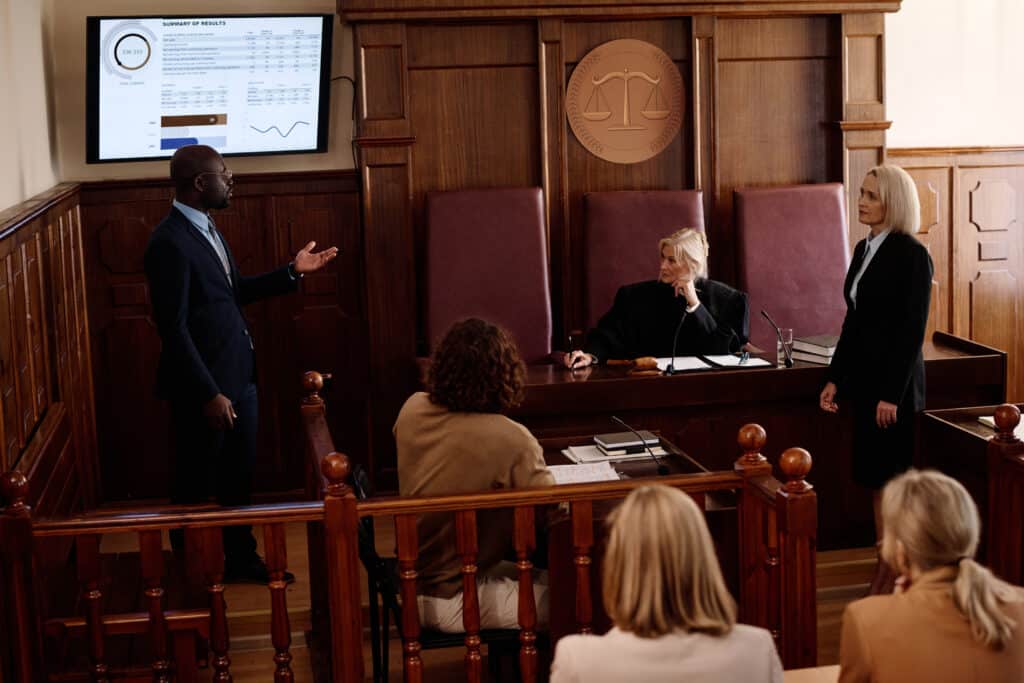

A conviction for terroristic threats carries penalties that scale with how the charge is graded, and the collateral damage often outweighs the criminal sentence itself. Students facing university disciplinary proceedings, parents with custody matters, and professionals with licensing concerns all face added exposure beyond the courtroom.
Every terroristic threats case starts with a close read of the actual words spoken or written, the context surrounding them, and whether the Commonwealth can prove genuine intent to terrorize rather than a poorly worded outburst. As an experienced criminal defense attorney, we pull phone records, social media history, and witness statements to reconstruct exactly what happened before charges were filed.
We also scrutinize how the statement was reported and investigated. Many terroristic threats cases begin with a secondhand account, an out-of-context text message, or a report filed after a falling-out between roommates or partners, and a defense attorney who challenges the reliability of that evidence can often negotiate a reduction or outright dismissal before trial.
When a case proceeds toward a preliminary hearing, our approach is to test the Commonwealth’s evidence early rather than wait until trial. A preliminary hearing attorney who pushes back at this stage can sometimes get charges dismissed or downgraded, sparing clients months of uncertainty and the stress of a pending felony.

Central Pennsylvania families and students turn to our firm because we approach every terroristic threats accusation with the seriousness it deserves, without losing sight of the person behind the charge.
Terroristic Threats FAQ
Can a terroristic threat be charged as a felony even if I never intended to hurt anyone?
Does a terroristic threats charge automatically lead to university discipline?
What happens at the preliminary hearing for a terroristic threats case?
Can a terroristic threats charge be expunged from my record later?

If you or someone in your family has been charged with making a terroristic threat in State College, Bellefonte, Altoona, Lewistown, or Lock Haven, the choices made in the first few days can shape the entire outcome of the case. Call our office at (814) 234-9500 or visit us at 611 University Dr Suite 213, State College, PA, 16801 to speak directly with an attorney who will walk through the charge, the evidence, and a realistic path forward.